


TL;DR
- Ronaldinho’s smile was one of the most recognizable features in football history.
- In 2013, the Brazilian football icon reportedly underwent gingivectomy (gum contouring surgery) and received approximately 10 porcelain veneers as part of a public smile makeover.
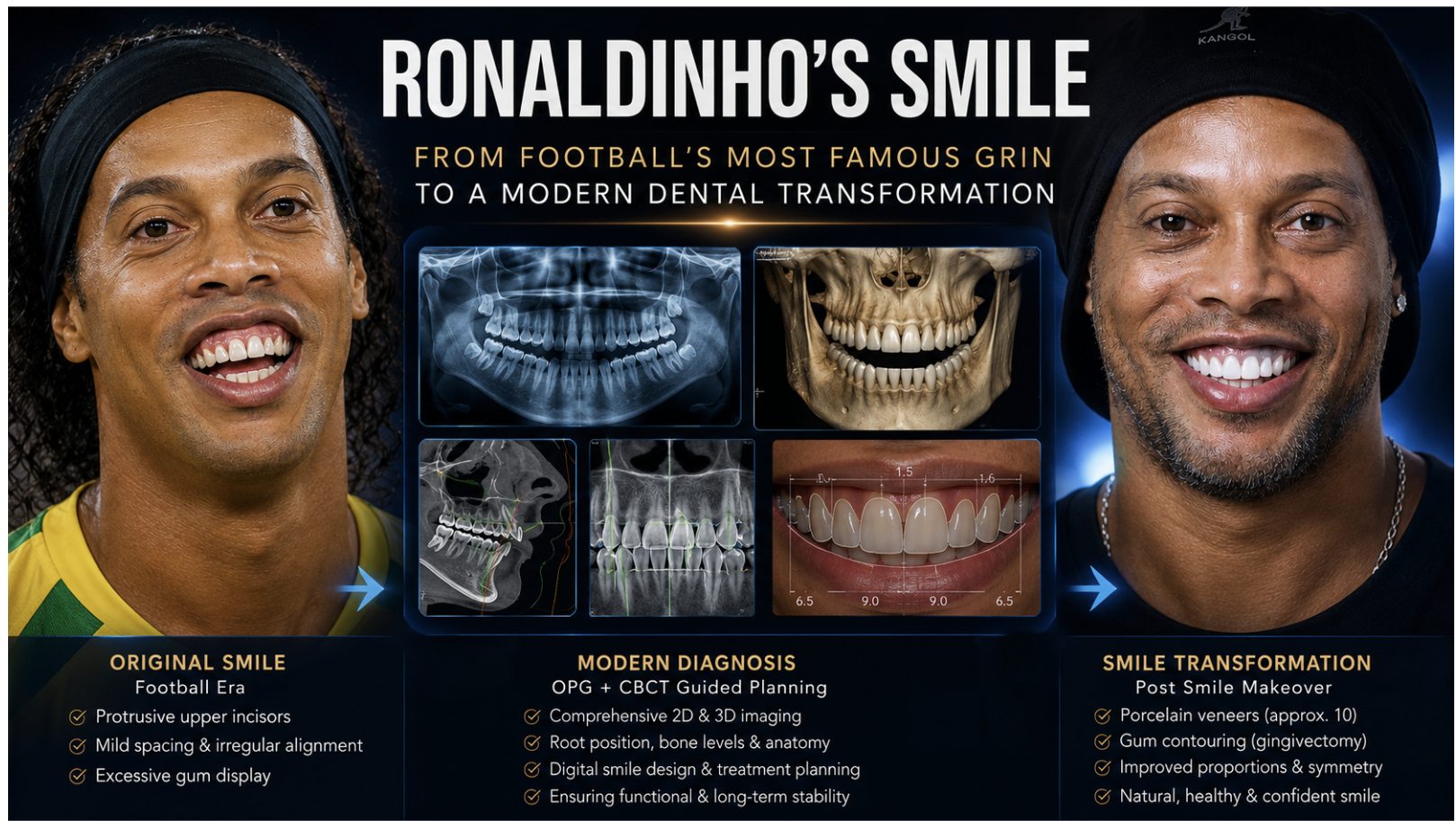
- His original smile was characterized by protruding upper front teeth, irregular alignment, and noticeable gum display.
- Cases like this involve much more than cosmetic improvements. Dentists must evaluate tooth position, root orientation, bone support, bite relationships, and gum architecture before treatment begins.
- Modern smile makeovers increasingly rely on OPG and CBCT imaging to improve treatment planning and long-term stability.
- Ronaldinho’s transformation demonstrates how contemporary dentistry combines aesthetics, function, diagnostics, and digital planning to create predictable outcomes.
Direct Answer
Ronaldinho’s smile makeover reportedly involved gingivectomy and porcelain veneers to improve tooth proportions, gum display, and overall smile harmony. While the results appeared cosmetic, modern dentistry approaches cases like this through comprehensive diagnosis first. Today, clinicians often use OPG and CBCT imaging to evaluate underlying bone, root position, bite relationships, and gum architecture before planning veneers or gum contouring procedures. The goal is not simply a better-looking smile but a smile that remains healthy, functional, and stable over the long term.
What Makes Ronaldinho’s Smile a Dental Case Study?
For football fans, Ronaldinho’s smile symbolized joy. It appeared in goal celebrations, interviews, magazine covers, and some of football’s most iconic photographs. His broad grin became almost as recognizable as his dribbling skills.
Yet from a dental perspective, Ronaldinho’s smile represented something equally interesting: a combination of aesthetic features that many patients ask dentists about every day.
Reports indicate that Ronaldinho underwent gingivectomy and received approximately 10 porcelain veneers in 2013 after years of public attention focused on his teeth. The transformation generated global discussion because people immediately noticed the difference.
What most people did not see was the diagnostic process that likely happened before any cosmetic treatment began. Modern smile makeovers are rarely about simply making teeth whiter. They involve understanding how teeth, gums, bone, lips, and facial proportions work together.
Understanding the Dental Features Behind Ronaldinho’s Original Smile
Several characteristics contributed to Ronaldinho’s distinctive appearance.
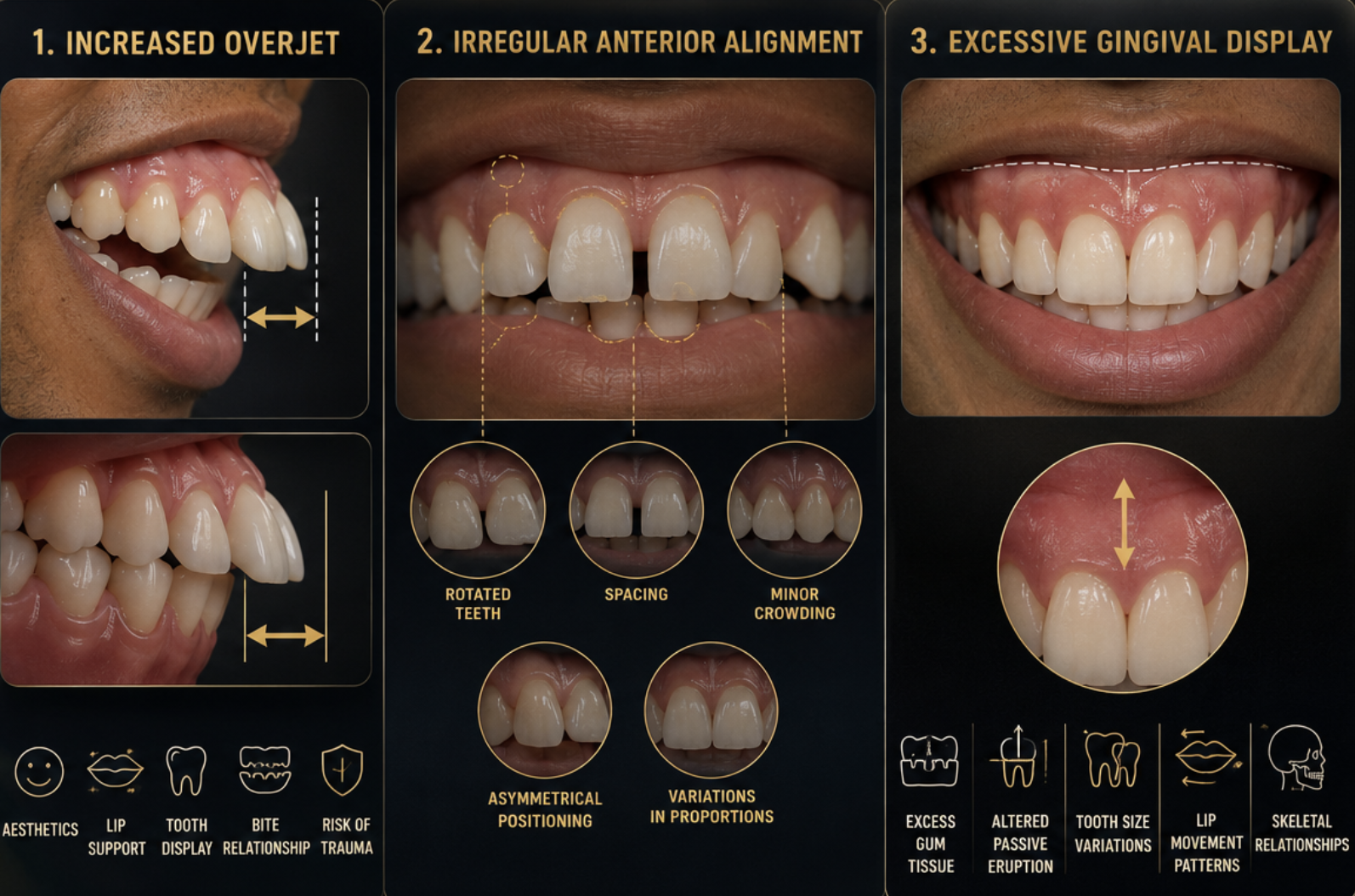
Increased Overjet
One of the most visible features was the forward position of his upper front teeth. In clinical dentistry, this is often described as increased overjet or proclined maxillary incisors.
Excessive overjet can influence:
- Smile aesthetics
- Lip support
- Tooth display
- Bite relationships
- Risk of trauma to front teeth
Many people live comfortably with increased overjet, but some choose correction for aesthetic or functional reasons.
Irregular Anterior Alignment
Public photographs frequently showed mild irregularities in the alignment of the upper front teeth.
This may include:
- Rotated teeth
- Minor crowding
- Asymmetrical tooth positioning
- Variations in tooth proportions
These conditions do not necessarily indicate disease, but they can influence smile symmetry and overall aesthetics.
Excessive Gingival Display
Another noticeable feature was visible gum tissue while smiling. This is commonly known as a “gummy smile.” Reports suggest Ronaldinho underwent gingivectomy as part of his smile makeover.
A gummy smile can result from several factors, including:
- Excess gum tissue
- Altered passive eruption
- Tooth size variations
- Lip movement patterns
- Skeletal relationships
The appropriate treatment depends on the underlying cause.
Why Cosmetic Dentistry Starts with Diagnosis
One of the biggest misconceptions about veneers is that they simply cover visible teeth. In reality, successful cosmetic dentistry begins with diagnosis.
Before planning treatment, clinicians need answers to important questions:
- Are the roots healthy?
- Is there adequate bone support?
- Are bite forces stable?
- Is gum architecture healthy?
- Can treatment remain stable long-term?
As cosmetic dentist Dr. Michael Apa explains:
“Veneers are a type of dental restoration, just like a filling or crown. We use porcelain to cover people’s teeth to change the shape and size and make it what they want.”
That process requires understanding far more than what is visible in a photograph.
Why an OPG Remains Important Before Smile Makeovers
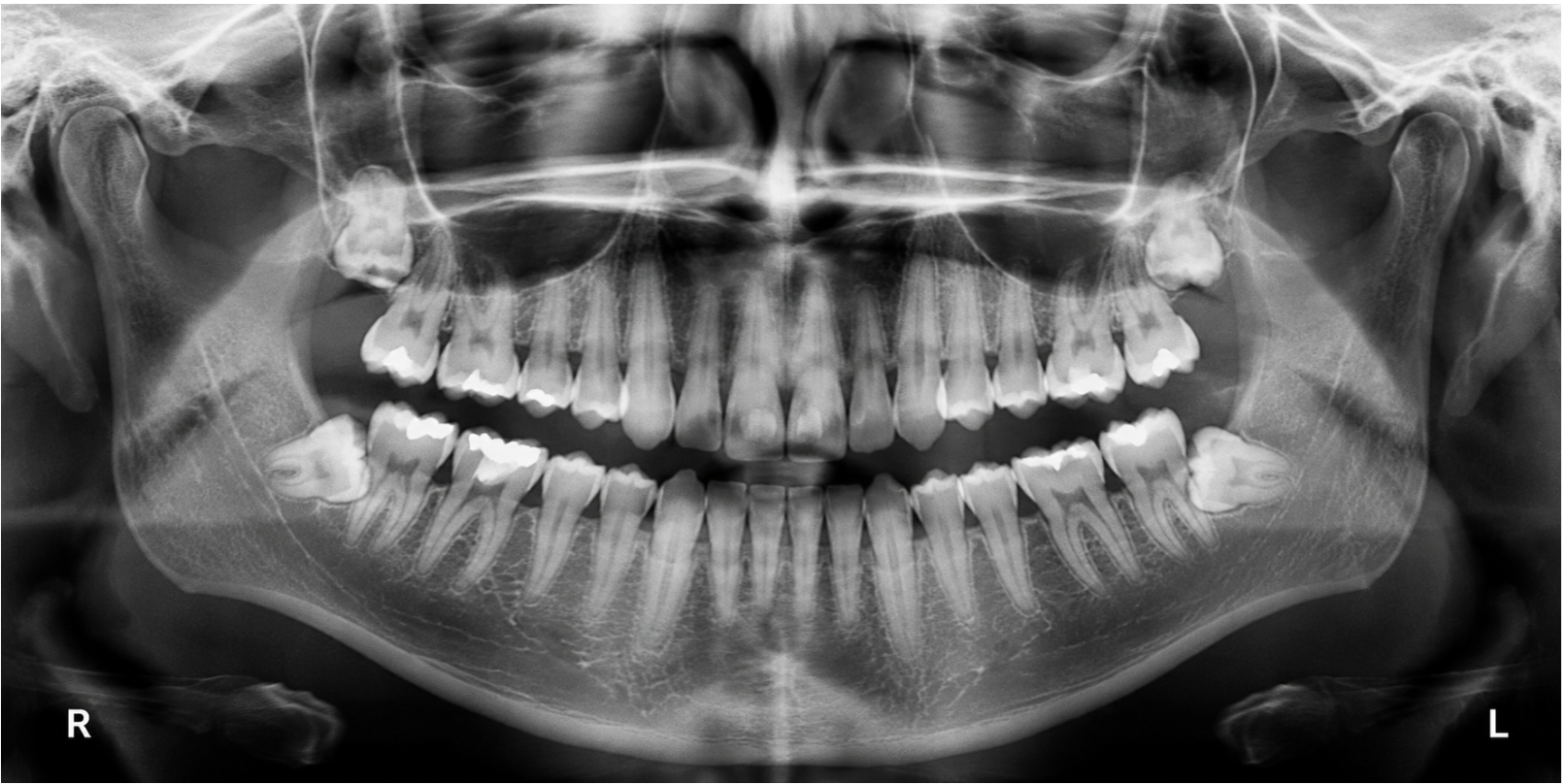
Before major cosmetic treatment, many dentists begin with an Orthopantomogram (OPG).
An OPG provides a panoramic overview of:
- Upper jaw
- Lower jaw
- Tooth roots
- Bone levels
- Wisdom teeth
- Temporomandibular joints (TMJ)
Although it is a two-dimensional image, it remains one of the most valuable screening tools in dentistry.
For a case like Ronaldinho’s, an OPG could help identify:
- Hidden infections
- Bone loss
- Root abnormalities
- Impacted teeth
- Existing restorations
- Jaw-related concerns
Think of an OPG as the roadmap before treatment planning begins. It helps clinicians understand the overall oral environment before moving into more detailed evaluation.
Where CBCT Changes the Game
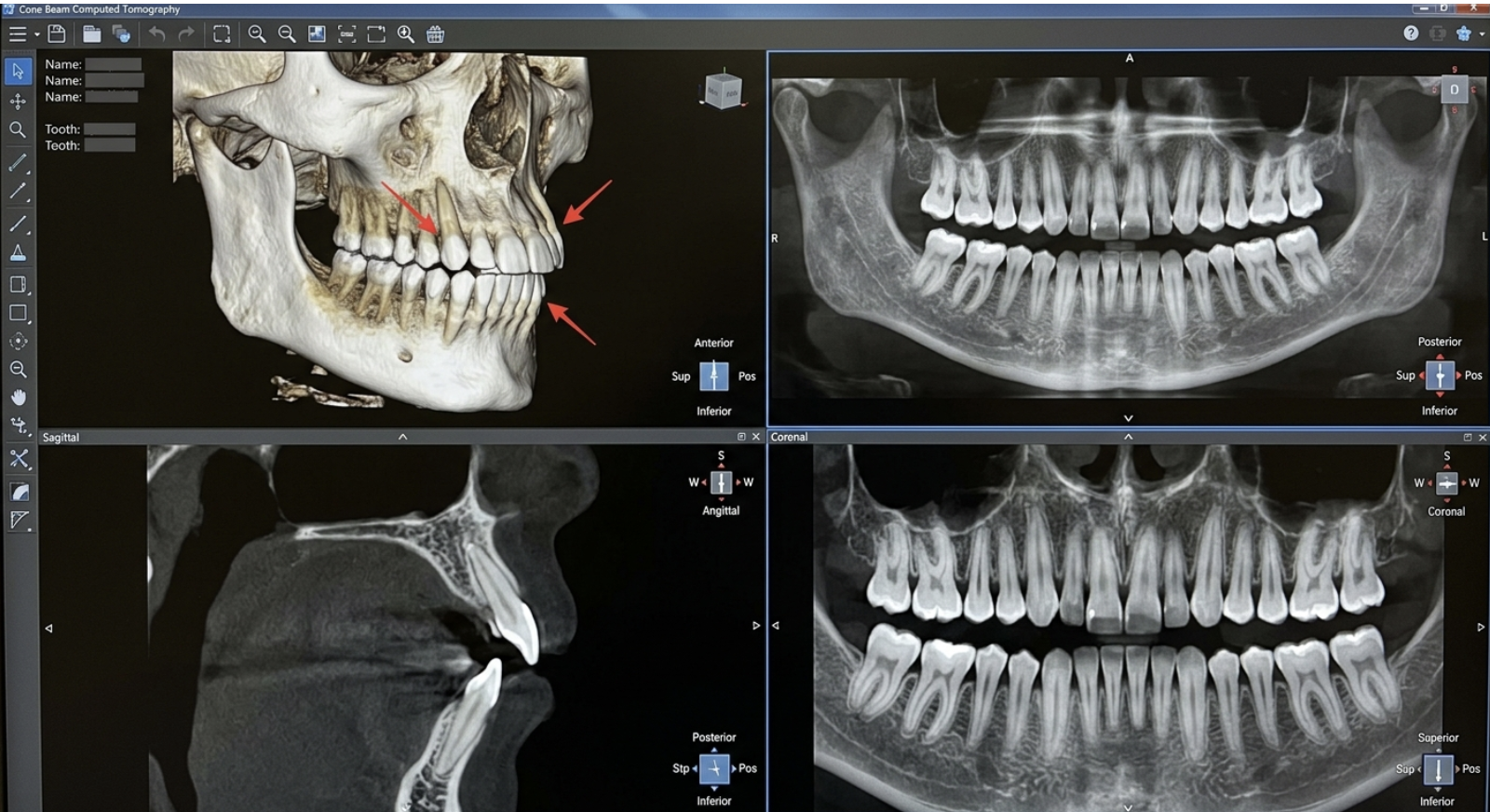
While OPG provides a broad overview, CBCT (Cone Beam Computed Tomography) provides depth.
CBCT creates three-dimensional images of:
- Tooth roots
- Alveolar bone
- Jaw structures
- Root angulation
- Bone density
- Facial anatomy
This allows clinicians to evaluate structures that traditional imaging cannot fully visualize.
For patients considering veneers, orthodontics, gum contouring, or future implant treatment, this information can be extremely valuable.
How CBCT Supports Complex Smile Design
In a case involving protrusive teeth, alignment concerns, or gum contouring, CBCT can help assess:
| Treatment Question | How CBCT Helps |
| Are roots positioned correctly? | Evaluates root angulation and proximity |
| Is there adequate bone support? | Measures bone height and thickness |
| Can teeth be moved safely? | Assesses orthodontic limitations |
| Is future implant treatment possible? | Evaluates bone availability |
| Will treatment remain stable? | Helps predict long-term outcomes |
This level of information reduces guesswork and improves treatment predictability.
Ronaldinho’s Transformation Reflects a Bigger Industry Trend
Ronaldinho’s makeover happened more than a decade ago, but it mirrors a much larger shift in modern dentistry.
According to recent industry data:
- The global cosmetic dentistry market is projected to reach approximately $31.31 billion in 2026.
- Around 600,000 Americans receive veneers annually, representing a significant increase compared to previous years.
- Approximately 90.7% of cosmetic dentists report increasing demand driven by social media influence.
- About 90% of veneer patients report significant smile improvements after treatment.
- Modern porcelain veneers demonstrate a 94.4% survival rate at five years.
These statistics highlight an important reality. People are no longer seeking cosmetic dentistry simply to improve appearance. They increasingly view smile design as part of confidence, self-image, and long-term oral health.
What Ronaldinho’s Smile Teaches Modern Patients
The most important lesson from Ronaldinho’s transformation is that successful cosmetic dentistry is rarely just cosmetic. The visible result may be whiter, straighter, or more symmetrical teeth. The real work happens beneath the surface.
Today, dentists increasingly combine:
- Clinical examination
- OPG imaging
- CBCT evaluation
- Digital smile design
- Facial analysis
- Restorative planning
to create treatment plans that balance aesthetics with biology and function. A beautiful smile is important. A healthy smile that remains stable for years is even more important.
Why Modern Smile Design Starts With Diagnosis
Ronaldinho’s smile was never simply a celebrity talking point. It became one of the most recognizable smiles in football history and later one of the most visible examples of modern cosmetic dental transformation.
His reported gingivectomy and porcelain veneer treatment demonstrate how contemporary dentistry goes beyond aesthetics alone. Before treatment begins, clinicians must understand tooth position, root anatomy, gum architecture, bone support, and long-term stability.
Today, OPG provides the overview and CBCT provides the details. Together, they help clinicians understand not only what can be improved, but also what must be preserved. Because successful smile makeovers are not just about creating a better smile.
They are about creating a smile that remains attractive, functional, and biologically stable for the long term.
The Bigger Lesson Behind Ronaldinho’s Smile Transformation
Ronaldinho’s smile makeover is a reminder that modern dentistry is about far more than appearance.
Whether someone is considering veneers, gum contouring, orthodontics, or a complete smile makeover, successful treatment starts with understanding what is happening beneath the surface. Tooth position, gum architecture, root anatomy, bone support, and bite relationships all influence the final result.
That is why advanced dental imaging has become such an important part of modern treatment planning.
At Nidaan Dental, advanced imaging solutions such as CBCT and OPG help dentists and specialists evaluate cases with greater accuracy before major restorative, cosmetic, implant, or orthodontic procedures are performed.
If you’re interested in learning more about smile design, dental imaging, CBCT technology, or cosmetic dentistry, explore more educational resources through Nidaan’s blog and diagnostic services.
Looking for advanced dental imaging?
Explore Best CBCT and OPG Scan in Pune for radiologist-reviewed dental imaging, CBCT scans, OPG scans, and comprehensive diagnostic support. Because the best smile makeovers are built on accurate diagnosis, not assumptions.
Frequently Asked Questions (FAQs)
What dental treatment did Ronaldinho reportedly undergo?
According to publicly reported information, Ronaldinho underwent a smile makeover in 2013 that reportedly included gingivectomy (gum contouring surgery) and approximately 10 porcelain veneers. The treatment was intended to improve the appearance of his teeth and gum display while creating a more balanced smile.
The procedure became widely discussed because Ronaldinho’s original smile had become one of the most recognizable features in world football.
Why was Ronaldinho’s smile considered unique?
Ronaldinho’s smile was instantly recognizable due to a combination of factors, including prominent upper front teeth, mild dental irregularities, and noticeable gum display.
For many fans, these features became part of his identity. Several football publications even described his smile as one of the most iconic in football history.
His smile symbolized joy, confidence, and personality, which is why his transformation attracted significant public attention.
What is a gingivectomy and why is it performed?
A gingivectomy is a dental procedure that involves reshaping or removing excess gum tissue around the teeth.
Dentists may recommend gingivectomy for several reasons:
- Improving smile aesthetics
- Reducing excessive gum display (“gummy smile”)
- Enhancing tooth proportions
- Improving access for oral hygiene
- Managing certain periodontal conditions
The goal is not simply removing gum tissue but creating better harmony between the teeth, gums, and lips.
What are porcelain veneers and how do they improve a smile?
Porcelain veneers are thin ceramic shells bonded to the front surfaces of teeth.
They are commonly used to improve:
- Tooth shape
- Tooth size
- Smile symmetry
- Tooth color
- Minor alignment concerns
- Surface imperfections
According to cosmetic dentistry industry data, approximately 600,000 Americans receive veneers annually, and patient satisfaction rates remain among the highest in elective dentistry.
Modern porcelain veneers are designed to closely mimic the appearance of natural tooth enamel.
How long do porcelain veneers typically last?
The longevity of veneers depends on factors such as oral hygiene, bite forces, treatment quality, and maintenance.
Current clinical data suggests:
- Porcelain veneers often last between 5 and 15 years.
- Studies report approximately 94.4% survival rates at five years.
With proper care and regular dental follow-up, many patients maintain their veneers successfully for well over a decade.
Would Ronaldinho’s smile makeover require advanced imaging today?
In modern dentistry, comprehensive imaging is frequently used before significant cosmetic treatment.
If a patient presented with similar concerns today, clinicians might consider:
- Clinical examination
- OPG imaging
- CBCT imaging (when indicated)
- Digital smile design
- Bite analysis
These diagnostic tools help evaluate tooth position, root anatomy, bone support, and long-term treatment stability before any cosmetic procedures begin.
What is the role of an OPG scan in cosmetic dentistry?
An OPG (Orthopantomogram) is a panoramic dental X-ray that provides an overview of the entire mouth.
Before cosmetic treatment, an OPG can help identify:
- Hidden infections
- Bone loss
- Impacted teeth
- Root abnormalities
- Existing restorations
- Jaw-related concerns
Although it is a two-dimensional image, it remains one of the most valuable screening tools in dentistry and often serves as the first step in treatment planning.
Why might a dentist recommend CBCT before veneers or smile design?
CBCT (Cone Beam Computed Tomography) provides three-dimensional imaging of teeth, roots, bone, and surrounding structures.
A dentist may recommend CBCT when they need more detailed information about:
- Root angulation
- Bone thickness
- Tooth positioning
- Orthodontic limitations
- Implant planning
- Anatomical structures
Unlike traditional X-rays, CBCT allows clinicians to evaluate anatomy from multiple angles, helping improve treatment predictability and long-term outcomes.
Are veneers only used for celebrities?
No. While veneers are commonly associated with celebrities, athletes, and public figures, they are used by a wide range of patients.
People may choose veneers to address:
- Chipped teeth
- Discoloration
- Uneven tooth shapes
- Minor spacing issues
- Smile asymmetry
- Cosmetic concerns affecting confidence
Modern cosmetic dentistry has become increasingly accessible, and treatment options are often customized to individual goals and oral health needs.
What is the biggest misconception about smile makeovers?
One of the most common misconceptions is that smile makeovers are purely cosmetic.
In reality, successful smile design requires careful consideration of:
- Function
- Bite stability
- Gum health
- Bone support
- Tooth structure
- Long-term maintenance
A beautiful smile that cannot be maintained is not considered a successful outcome.
Modern dentistry focuses on creating smiles that are not only attractive but also healthy, functional, and stable for years to come.
What can patients learn from Ronaldinho’s dental transformation?
The biggest lesson is that great cosmetic dentistry starts with diagnosis. Ronaldinho’s reported transformation may appear simple when viewed through before-and-after photographs, but treatments involving veneers, gum contouring, or smile redesign require careful planning.
Today, dentists increasingly rely on advanced imaging, digital workflows, and comprehensive evaluations to understand:
- What can be improved
- What should be preserved
- What will remain stable long term
The result is a treatment plan that balances aesthetics with oral health and function.
Ultimately, Ronaldinho’s story demonstrates that modern dentistry is not about creating a perfect smile—it is about creating the right smile for the individual behind it.